
The period 1992 to 2008 was Britain’s most golden era. The Berlin Wall had fallen in November 1989. From 1992 to 2008 there were 63 consecutive quarters of economic growth – driven by North Sea Oil, the EU Single Market and China joining the World Trade Organisation.
Then came a succession of shocks – the 2008 banking crisis, the Brexit strategic blunder, Covid and President Trump. As a result, that golden era is now history. It is not coming back. The world has become far harsher place within which Britain has to pay its way.
The new era is defined by growing rivalry between the US and China economic superpowers, with substantial swings back toward government intervention and industrial policy globally. Success will beget success; failure will beget failure. AI itself has also changed the calculus. Unlike previous technology waves, AI's pervasiveness and impact on competitiveness means the cost of failure is existential, not merely embarrassing.
Against this backdrop the Government’s AI Opportunity Action Plan is not just another Johnson style government initiative whose primary political purpose is just a good headline next day. It is a serious plan for Britain rebuilding its economy, public services and technology base. It has to succeed.
But the mistakes of the 5G global leadership initiative have not been learnt. The AI Action Plan has been launched within the same flawed legacy framework. Without a course correction, it will finish in ten years from now where the 5G global leadership initiatives finished ten years after its launch – nowhere!
Our book The Graveyard of Good Intentions is the first thoroughly researched and evidenced based conclusions on “the British problem” of half-baked technology strategies. However, it only sign posts where the solutions are to be found. It falls to those in positions of power to take the decisive steps. They will find their efforts well rewarded. It will secure for Ministers their legacies. It gives Officials the evidence base they have lacked to make a compelling case for giving them the powers needed to succeed and, of course, getting the all important AI Opportunities Action Plan onto a winning path. That in turn will give the country a far brighter future.
This Web Site has the limited objective to support the book with back-up material, including short articles and how the Ten Golden Rules were automated using three AI Platforms in a high integrity configuration.
One of the by-products of our research was how to use AI Platforms for complex evaluations to produce outputs that can be trusted. It involved a novel error suppression protocol applied to running the same evaluation on three different AI platform in parallel. It is an approach that anyone can apply to make the AI Platforms they use for their work more trustworthy. (Click on "Making AI Platforms More Trustworthy" on the side panel)
Read more
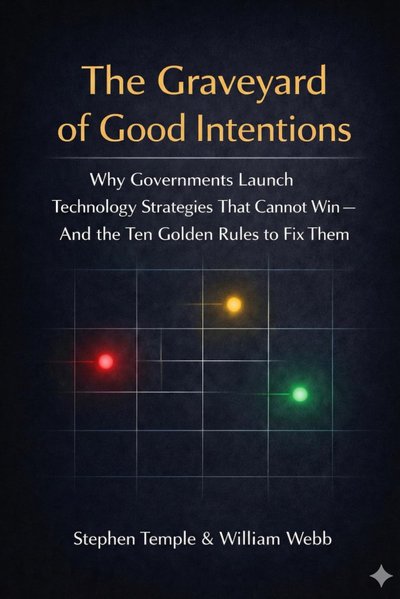
Why Governments launch technology strategies that cannot win - and the Ten Golden Rules to fix them.
All content here (c) copyright of Stephen Temple