
ABOUT STEPHEN TEMPLE
Civil Service career:
Laying the foundational framework for today’s seamless global mobile connectivity through his 1987 GSM Memorandum of Understanding that was to eventually align mobile operators worldwide behind global roaming and generational technology shifts powered by global economies of scale. Led the UK’s role in Europe’s transition to digital broadcasting and secured UK legislation enabling digital terrestrial TV and DAB. Advised President of the Board of Trade Michael Heseltine on telecoms and broadcasting industrial strategy.
Private Sector career:
Pioneering VMO2’s (then ntl’s) broadband Internet access technology. Integrated incompatible digital cable TV platforms following the cable company mergers. As Managing Director of NTL Networks Division, was responsible for post–Chapter 11 restructuring to deliver substantial efficiency gains. At Vodafone Group Strategy, challenged the company’s long-standing wireless “pure-play” vision that pivoted the German business towards backing both mobile and wireline broadband.
Post-retirement academic career:
accepted a role as visiting professor at the University of Surrey 5G Innovation Centre, where his focus was the intersection of technology change, regulation, spectrum and government policy. He led Europe’s efforts to sort out a 5G radio spectrum impasse and created the 5G pioneer band solution. He initiated a number of 5G/6GIC White Papers – the most recent was a re-set of the University of Surrey 6GIC vision that aligned the views of the UK’s mobile network operators behind a highly reliable Artificial Intelligent (AI) ready national mobile infrastructure.
Awards:
He was awarded a CBE in 1996 for services to trade and industry. He won the 1994 IEEE prize for international communications and the 1996 GSM Association Chairman's Award for Outstanding Achievement. He is a Fellow of the Royal Academy of Engineering and the IET.
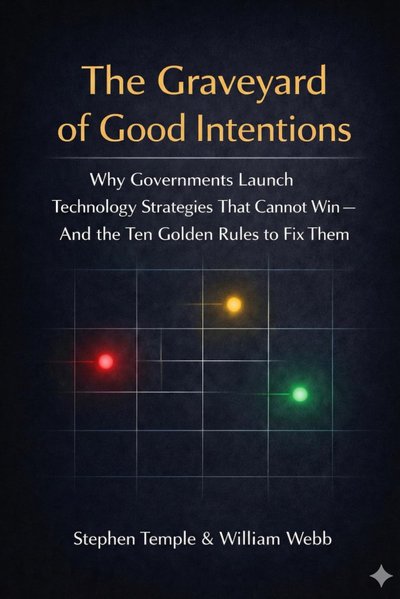
Why Governments launch technology strategies that cannot win - and the Ten Golden Rules to fix them.
All content here (c) copyright of Stephen Temple