
Forty years ago, an ideological war was fought between the "wets" (believing in industrial policy) and the "dry’s" (believing governments had no role in "picking winners"). Margaret Thatcher's inner circle coined these terms. The dry’s won decisively.
The market would determine outcomes. Government handed its intervention levers to independent regulators whose parliamentary mandates hardwired them to promote competition and deliver low consumer prices. The Treasury's role became containing public expenditure. "Technology neutrality" was elevated to sacred principle. Reaction times for any change would be slowed by requiring substantial evidence bases before action.
This framework wasn't designed for technology leadership. It was designed to prevent government intervention.
Over the next forty years, perhaps four serious efforts were made to revive industrial policy. None survived. Any momentum generated was ground down by the imperfections of this legacy framework, then finished off completely with the next political swing of the pendulum back toward non-intervention ideology.
The wiring of the machinery of government all of these years ago to make industrial interventions difficult is largely still in place today. It is the flawed legacy framework that has blighted the prospects of every recent technology initiative having bold global ambitions.
The 5G Case: Good People, Impossible Framework
The recently published book "Graveyard of Good Intentions: Why Governments Launch Technology Strategies That Cannot Win" documents this dynamic of launching technology initiatives through a flawed legacy framework. It is exposed in uncompromising detail in the story in five acts of the UK bid for 5G global leadership. The analysis of what happened makes painful reading for those involved, who did everything possible for the initiative to succeed.
The Critical Question
When the strategy errors were so basic and visible at the time, it begs the question: how could this have happened?
The explanation is straightforward.
The clock was ticking. 5G was gathering international momentum. An initiative had to launch. There were two paths: work within the imperfect legacy framework or break out of it entirely.
Breaking out would have required expending enormous political capital - building the evidence base, fighting fiercely independent regulators, battling for parliamentary slots to change legislation.
The path of least resistance was launching within the existing framework, hoping, with a bit of luck, things might be different this time.
I challenge anyone to say they would have chosen the harder path - or braver still, pressed the kill-switch on an initiative unlikely to succeed.
This same dynamic explains why today's AI Opportunity Action Plan has launched down the same constrained path where a rigorous Ten Golden Rules diagnostic shows global leadership is patently out of reach.
Why Now Is Different
Two factors have changed fundamentally.
First, the world has become far harsher. We're in an era defined by growing rivalry between the US and China, with substantial swings back toward government intervention and industrial policy globally. Success will beget success; failure will beget failure. The UK cannot afford more half-baked strategies that waste billions without delivering returns. Second, AI itself changes the calculus. Unlike previous technology waves, AI's pervasiveness and impact on competitiveness means the cost of failure is existential, not merely embarrassing.
The UK has no choice but to learn - very quickly - how to launch successful technology interventions.
The Way Forward: The Two Options
The Ten Golden Rules provide a success checklist for technology leadership initiatives. But they are just a guide. The real work falls to those with the onerous tasks of breaking out of the imperfect legacy framework.
They have two choices.
High on ambition but lengthy to implement - The first is root-and-branch transformation of the entire framework. That's a 5-10 year undertaking requiring sustained political will across election cycles.
Moderate the ambition and shorten the time - The second is to create a modernised framework specifically for a handful of identified technologies where the UK has genuine competitive strengths and potential for global leadership. This could be accomplished in 18 months.
This targeted approach could serve as the pilot run that provides the evidence base for broader transformation to follow. It would give very senior policymakers the levers of power they've lacked for forty years - powers to make strategic technology investments, coordinate across departments and regulators, move at market speed, and take calculated risks on emerging opportunities. Most importantly, it would break the cycle of launching strategies doomed by structural constraints.
Read more
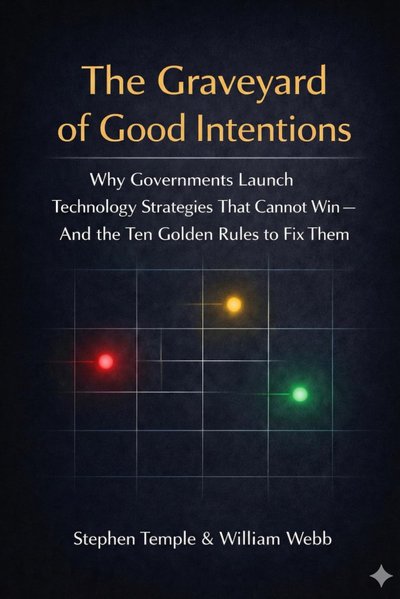
Why Governments launch technology strategies that cannot win - and the Ten Golden Rules to fix them.
All content here (c) copyright of Stephen Temple